A fragrance brief is a product decision written down, not a mood board. Projects that get a usable sample in the first or second round almost always share one habit: the brief fixes the commercial frame, the wear experience and the product base before anyone discusses notes. Projects that drag through six rounds of sampling usually skipped one of those three, and the perfumer is left guessing at a target nobody wrote down.
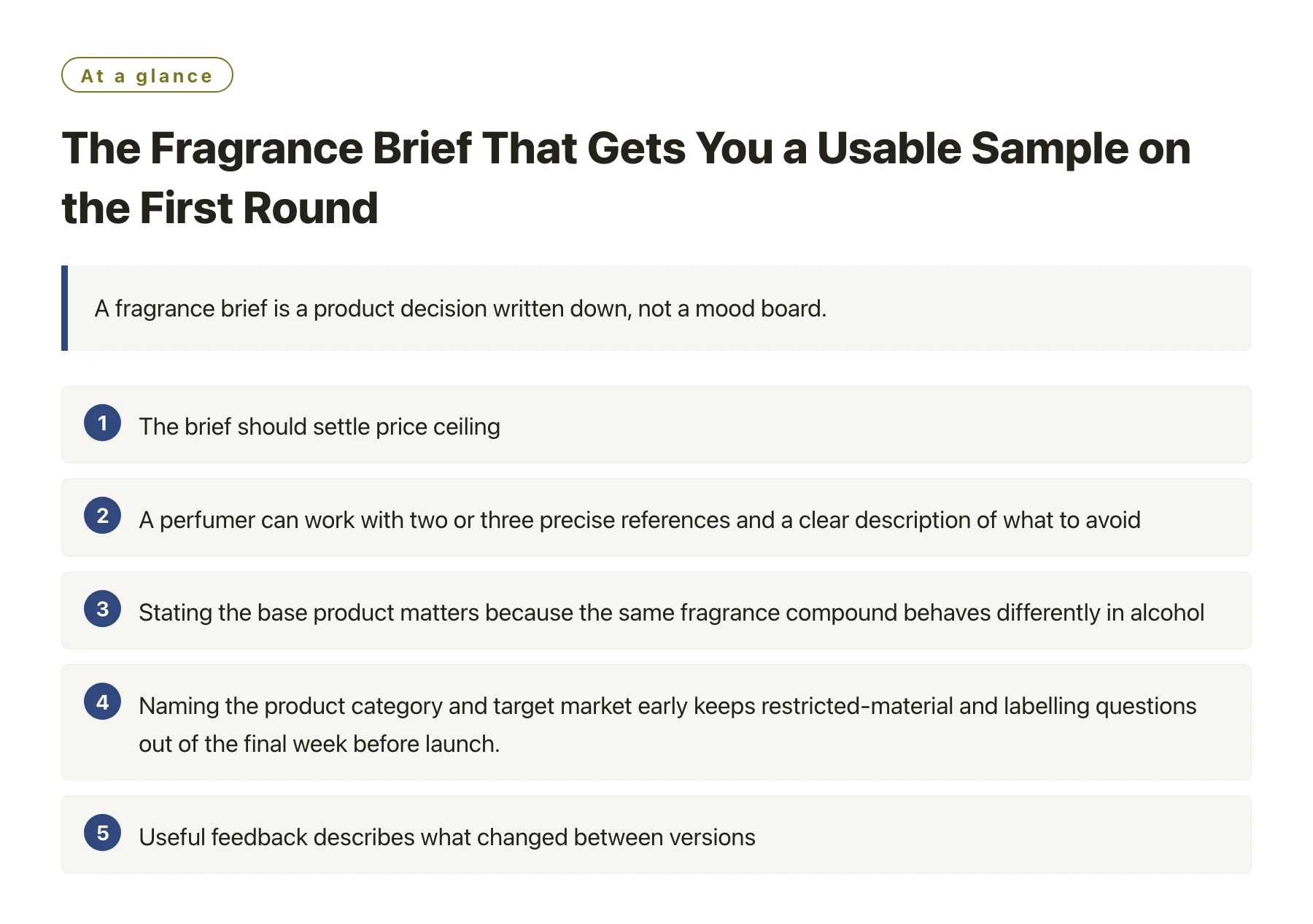
Key takeawaysThe brief should settle price ceiling, target market, product base and wear profile before any scent direction is discussed. · A perfumer can work with two or three precise references and a clear description of what to avoid; ten references is a mood board, not a brief. · Stating the base product matters because the same fragrance compound behaves differently in alcohol, in a cream and in a candle wax. · Naming the product category and target market early keeps restricted-material and labelling questions out of the final week before launch. · Useful feedback describes what changed between versions, on skin, at a named hour, rather than whether the sample was liked.
Custom fragrance projects rarely fail at the perfumery stage. They fail at the briefing stage, and the failure is quiet: a sample arrives, it is pleasant, it is not the product, and nobody can say precisely which instruction was missed because no instruction was written.
The result is an expensive loop. Each round costs sampling time, courier time and decision time, and after the third round the feedback starts drifting toward whatever the last sample smelled like rather than toward the original intention.
What follows is a working structure for a perfume brief, the fields that carry the most weight, and the failure patterns that show up most often when a brand is developing its first fragrance. It is written for founders and product managers who are commissioning development rather than doing it, and it assumes no perfumery vocabulary beyond the ability to describe what you want the product to do.
Fix the frame before you describe the smell
A brief that opens with a scent description has started in the wrong place. The commercial frame decides which formulations are even viable, and it is far cheaper to settle on paper than to discover after sampling.
Three decisions come first, and each one narrows the creative space in a useful way. Answer them in writing, in one page, before any reference material is sent.
The commercial frame
State the target unit cost ceiling for the fragrance compound, the retail price band, and the size of the first production run. The compound is the most expensive input in most fragrance products, so the ceiling does real work: it tells the developer which families of materials are available and which are not.
Add the channel. A product sold through a specialist retailer and one sold through a discount marketplace may share a scent direction and still need different cost structures and different packaging assumptions.
The wear experience
Describe when the product should be noticed, how far it should carry, and how long it should still be detectable. Those three sentences do more for a developer than any list of notes, because they translate directly into material choices with known volatility.
Climate belongs here too. A formula that reads as rich in a cool, dry market can feel heavy in a hot, humid one, so name the markets where the product will actually be sold.
The product base and category
A fragrance compound does not behave the same way in every base. Alcohol-based fine fragrance, an emulsion, a body oil and a candle wax each change how the materials lift and how the formula ages. Formulation and testing literature covers how fragrance interacts with the rest of a product, from viscosity to colour to stability, which is exactly why the base is a brief field and not an afterthought [1].
The category also determines which fragrance use restrictions apply. The standards maintained by the International Fragrance Association set different limits depending on the product type, so writing the category down early avoids a reformulation later [2].
From one-page brief to approved sample
- Write the one-page frameCost ceiling, retail band, first run size, markets, wear experience and product base, in the shortest form that is still unambiguous.
- Choose two or three references, not tenPick references that represent different directions rather than variations on one, and say what you want borrowed from each.
- Add an explicit avoid listName the materials, effects or categories you do not want. An avoid list removes more uncertainty than an extra reference adds.
- Agree the evaluation method in advanceDecide who will smell the sample, on paper first and on skin afterwards, and at which hours the wear will be judged.
- Test on more than one personSkin chemistry varies widely, so a sample judged on one wrist is a personal opinion rather than a product decision.
- Give feedback by version and by hourDescribe what changed from the previous round and where in the wear curve the problem sits, instead of saying which sample you liked.
- Freeze the formula before the labelConfirm the declaration-relevant details against the finished formula, then finalise packaging wording to match the confirmed version.
Brief fields, weak answers and workable ones
| Brief field | Weak answer | Answer a developer can use |
|---|---|---|
| Target wear | Long lasting | Noticeable for the first two hours, still detectable at hour six on skin |
| Projection | Strong | Aware within arm's length, without filling a room |
| References | A list of ten current bestsellers | Three references with a note on what to take from each |
| Product base | Perfume | Alcohol-based spray, 50 ml, no colourant, clear glass |
| Markets | Global | Two named markets with their climate and labelling requirements |
| Avoid list | Nothing cheap smelling | No heavy sweet accord, no strong patchouli, no overt fruit top |
The pattern in the right-hand column is the same in every row: a number, a direction or a named constraint. None of those answers require technical knowledge, and all of them remove guesswork. The left-hand column is not wrong so much as incomplete, and incomplete briefs are what turn a two-round project into a six-round one.
The single most useful sentence a founder can write in a brief is the one that describes the moment the product is meant for: where it is worn, by whom, and what should happen in the first ten minutes. That sentence tends to settle arguments later, when two samples are close and the team cannot agree. Keep it at the top of the document, above the cost ceiling, and read it out loud before each evaluation round. If the sentence changes between rounds, the brief has changed and the developer should be told.
Why first sampling rounds stall
When a project reaches round four without a decision, the cause is usually in the feedback rather than in the perfumery. Three patterns account for most of the delay, and all three are fixable in the next email.
Correcting them is also a good way to judge whether the development partner is doing real work. A developer who asks clarifying questions before sampling is protecting your budget; one who samples first and negotiates afterwards is not.
Chasing a reference that cannot be copied
Asking for a close copy of a competitor's fragrance sets up a project that cannot be finished cleanly, partly because the formula is unknown and partly because the result will always be compared to a product you cannot legally duplicate.
A better instruction names the impression the reference creates and the specific part of it you want, then lets the developer build something original around that.
Feedback with no direction in it
Comments such as too sweet, too sharp or not quite right are directional only if they are attached to a point in the wear curve. The same formula can open too sweet and dry down too flat, and those are different problems with different fixes.
Reference libraries that document aroma materials with odour descriptions and typical usage ranges are public, so a founder can check whether a proposed direction is plausible before approving a round [3].
Ignoring how the developer works
Large fragrance houses organise their creative and ingredient work by product family and market, which is a reminder that the same brief can be answered in several legitimate ways [4]. Knowing which direction your developer favours is useful context when you compare rounds.
The practical test is the response to the first brief. A custom perfume manufacturer in China that has run this process many times will usually push back on a vague brief before sampling rather than after, because the questions are cheaper than the material.
Sources
- Cosmetics & Toiletries —— A technical magazine for cosmetic formulators, covering ingredients, formulation science and testing methods.
- IFRA Standards Library (International Fragrance Association) —— The IFRA Standards Library lists the restrictions the fragrance industry applies to individual fragrance ingredients, based on safety assessments; it is the reference point for compliant fragrance formulation.
- The Good Scents Company —— A reference database of aroma materials with odour descriptions, CAS numbers and typical usage information.
- Givaudan —— One of the largest fragrance and flavour houses; public material on fragrance creation, ingredient portfolio and market segments.
Frequently asked questions
How long does custom perfume development usually take?
It depends mainly on how quickly decisions are made, not on the perfumery. A tight brief with fast, specific feedback can move from first sample to approved formula in a few rounds. Each additional evaluation loop adds laboratory time, sampling time and shipping time, which is why brief quality is the biggest schedule lever you control.
Do I need to know fragrance notes to write a brief?
No. You need to describe the experience, the market, the base product and the cost ceiling. Notes are the developer's vocabulary for reaching that experience. If you can say when the product should be noticed and how long it should last, that is enough to start.
How many samples should I expect before approving a formula?
There is no fixed number, but a well-briefed project usually needs fewer rounds. Plan for at least two, expect three on a first fragrance, and treat every round beyond that as a signal to re-read the brief before giving more feedback.
Can I change the formula after the packaging is printed?
Technically yes, but it is expensive. A formula change can affect the ingredient declaration and, in some markets, the product notification. Freeze the formula first, confirm the declaration details against it, and only then commit packaging artwork to print, because a late change usually means a reprint rather than an adjustment.
What is the difference between private label and custom development?
Private label adapts an existing formula and existing packaging options to your brand, which is faster and cheaper. Custom development writes a new formula around your brief. Many brands start with private label to test a market and move to custom development once the product line is proven.