How Much Range a Mid-Size SUV Needs in Australia
For most Australian households the answer is not the biggest number on the page — it is enough range to cover a normal week plus one long drive, with a margin for bad weather. The New G6 is published with up to 525 km of WLTP range, and that ceiling is the right place to start the arithmetic. What matters next is how often you actually drive further than that in one day.

Key takeaways
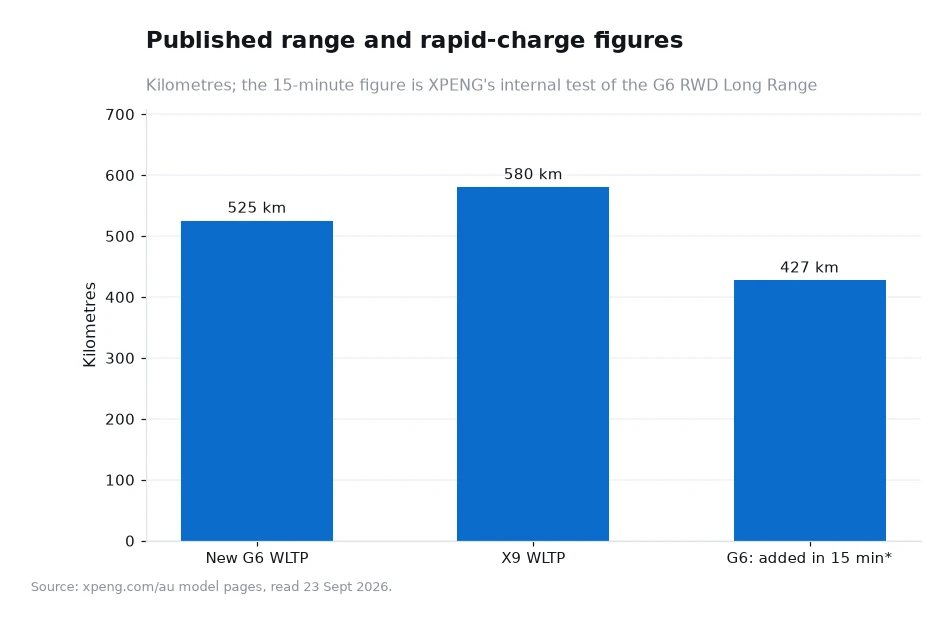
- Published WLTP range for the New G6 is up to 525 km, and for the seven-seat X9 up to 580 km; the WLTP figure depends on test conditions.
- A 10–80% state-of-charge top-up is published at 12 minutes on the 5C battery, which changes trip planning more than the ceiling does.
- Up to 427 km of charge in 15 minutes comes from XPENG's internal tests of the G6 RWD Long Range, so it is a variant-specific figure.
- Size your range around your worst regular week, not your best one, and treat real-world consumption as a labelled assumption of your own.
The short answer, before the numbers
A mid-size family SUV needs enough range to cover the longest drive you take without planning, plus a reserve you can spend on a hot day, a headwind or a detour. For a household that commutes during the week and takes one regional trip a month, a published ceiling in the region of 500 km is comfortable, because the week is short and the trip is infrequent. For a household that drives long distances every fortnight, the charging rate matters more than the ceiling, and that is a different calculation.
So there are two numbers to weigh, and buyers often weigh only the first. One is how far the car goes on a full charge. The other is how quickly it accepts energy when you stop. On a car with a fast charging curve, a slightly smaller ceiling costs you a few extra minutes a month. On a car with a slow curve, a large ceiling still leaves you standing at a charger on the one trip that matters.
The published ceiling and what it means
XPENG publishes up to 525 km of WLTP range for the New G6 and up to 580 km for the X9, the seven-seat MPV. Both cars sit on a full-domain 800V SiC platform, and the G6's platform is described on the Australian site as a Full-Domain 800V High-Voltage SiC Platform with 5C supercharging. In plain terms, the high-voltage architecture is what allows the battery to accept a large amount of power without the cables and cooling system becoming the bottleneck.
The word to notice is "up to". WLTP figures come from a standardised test cycle, and the manufacturer's own footnote is that WLTP range depends on conditions. Your conditions include ambient temperature, motorway speed, how loaded the car is, whether the air conditioning is working hard, the terrain, and even tyre pressure. None of that makes the published number wrong; it makes it a ceiling, and ceilings are useful as long as you know that is what you bought.
Charging speed is the second half of the answer
The New G6 is published at 10–80% state of charge in 12 minutes on its 5C battery, which the site headlines as Australia's first 5C AI Battery. The X9 carries the same 12-minute figure. A separate published number — up to 427 km of charge added in 15 minutes — comes from XPENG's internal tests of the G6 RWD Long Range, so it belongs to that variant and that test, not to every car in the range.
Put those two together and the shape of a long drive changes. You are rarely charging from empty to full on a trip; you are topping up to the point where the next leg is comfortable, then leaving. That is why the first part of the curve matters most, and why a 12-minute 10–80% window is more relevant to a family holiday than a range figure measured over a full cycle. The manufacturer's charging page also notes that XPENG vehicles are compatible with most public Type 2 AC and CCS2 DC fast chargers, which in practice means the planning question is where the stops are, not whether the car will fit the plug.
Published figures, with the condition attached to each
| Published figure | Model or condition |
|---|---|
| WLTP range up to 525 km | New G6, WLTP cycle |
| WLTP range up to 580 km | X9 seven-seat MPV |
| 10–80% state of charge in 12 minutes | 5C battery, both models |
| Up to 427 km added in 15 minutes | Internal test, New G6 RWD Long Range |
| 0–100 km/h in 4.13 s | New G6 AWD |
Sizing your own week
Write down four numbers before you look at a specification sheet: your daily commute, your weekly errands, your longest regular trip, and how many days a week the car sits at home. Those four numbers decide whether you are buying range or charging speed. A household that drives 40 km a day and parks in a driveway overnight needs far less ceiling than a household that tows a trailer or visits family four hours away.
A practical rule is to buy for the worst regular week rather than the best one. Anyone weighing an XPENG electric suv in the mid-size class can apply that rule directly: if one week a month includes a long drive, plan the car around that week and let the other three look easy. The reverse approach — buying for the easy week and hoping the hard week works out — is where range anxiety actually comes from.
Worked example: sizing a mid-size SUV for a suburban household
This is a labelled example with every assumption spelled out, not a manufacturer claim. Assume a 60 km round commute five days a week, which is 300 km. Add 80 km of weekend errands, giving 380 km a week. Assume real-world consumption is 18 kWh per 100 km and that the car returns roughly 400 km of real range from a full charge, which is a modelling assumption below the 525 km WLTP ceiling to allow for speed and air conditioning.
The weekly arithmetic: 380 km ÷ 100 = 3.8 blocks of 100 km. 3.8 × 18 kWh = 68.4 kWh consumed in the week. 68.4 kWh × $0.30 per kWh = $20.52 of electricity a week, or about $1,067 a year across 52 weeks. Against the assumed 400 km of real range, one full charge covers the week with about 20 km to spare, so the car needs to be plugged in once, not twice.
Now the trip arithmetic. Assume a 700 km holiday drive. Two top-ups of the published 12-minute 10–80% window add 24 minutes of charging in total, plus the time it takes to leave the highway and return. That is the number to compare against a coffee stop, not against a full recharge from empty. If instead the drive were 1,200 km, the same assumption of one stop every few hundred kilometres would put the charging time nearer 36 to 48 minutes across the day.
Frequently asked questions
Is 525 km enough for a family SUV in Australia?
For most suburban households it is more than a week of driving, and it covers a long regional trip with one planned stop, but it is a WLTP figure, so real range will vary with speed, temperature and load.
Should I choose the variant with more range or the one that charges faster?
If your weekly driving is short and your long trips are rare, either works; if you drive long distances often, weigh the published 12-minute 10–80% window more heavily, because time at the charger is what you feel.
The decision in one line
Buy enough range for the week you dislike, not the week you enjoy. For a mid-size SUV, the published ceiling of up to 525 km on the New G6 is a sensible anchor, and the 12-minute 10–80% window is what makes the occasional long drive painless.
Next step: write down your own four numbers, then compare them against the published figures rather than against a friend's opinion. If you are deciding between the size of a smart coupé SUV and the space of a seven-seater, drive both on the same route on the same day.
Specifications come from the manufacturer's Australian site at xpeng.com/au, read 23 Sept 2026, including the footnote that WLTP range depends on conditions and that the 427 km figure comes from internal tests of the G6 RWD Long Range. The 60 km commute, 380 km week, 18 kWh per 100 km, $0.30 per kWh and 400 km real-range figures are illustrative assumptions, not manufacturer data.[1]