Three Rig Sizes, Three Paychecks: Daily Math at $84,692
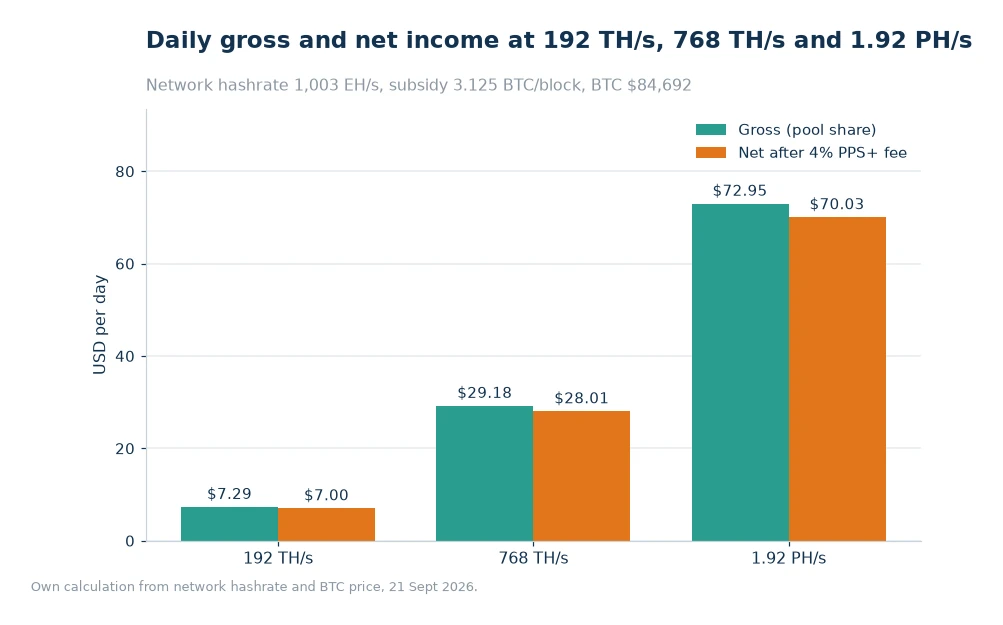
Hardware shopping gets simpler when every candidate quotes the same currency: dollars per day. At 192 TH/s the network division gives 0.00008613 BTC daily, $7.29 gross and $7.00 after the listed 4% on the block-reward slice. Scale to 1.92 PH/s and the day pays $72.95 gross, $70.03 net, at $84,692 per coin.
Key takeaways
- 192 TH/s grosses $7.29 a day and nets $7.00 after the listed 4% on the block-reward component.
- 768 TH/s grosses $29.18 a day and nets $28.01 under the same fee treatment.
- 1.92 PH/s grosses $72.95 a day and nets $70.03, all at BTC $84,692.
- Inputs are fixed at 21 Sept 2026: 1,003 EH/s network, 450 BTC daily issuance, 132.76 T difficulty.
Turning terahash stickers into daily wages
Vendors advertise terahash the way employers advertise job titles: impressive, abstract, and silent about take-home pay. The conversion is one division. Each TH/s earns 450 BTC divided by roughly 1,003,000,000 TH/s of network, about 0.00000044865 BTC a day. A 192 TH/s machine therefore credits 0.00008613 BTC daily, and dollars enter only at the last step through the $84,692 price.
That wage framing exposes weak deals fast. A rig priced 40% above its shelf-mate while hashing 10% faster is a pay cut dressed as an upgrade. Run every candidate through gross dollars per day first, subtract power at your tariff second, and only then admire the enclosure. Hashrate earning power is arithmetic; everything else is packaging.
The three paychecks side by side
The chart lines up three realistic rungs. The 192 TH/s single-machine tier grosses $7.29 and nets $7.00. The 768 TH/s shelf, roughly four such machines, grosses $29.18 and nets $28.01. The 1.92 PH/s small-room tier grosses $72.95 and nets $70.03. Net here means after the listed 4% on the PPS-settled block-reward component, the standard PPS+ treatment for miners who want hourly settlement against current difficulty.
Notice the ratios hold exactly: each tier is a clean multiple of the first, so the dollars scale without surprises. That linearity is the shopper's friend. Once the smallest tier's economics are verified against a real power bill, the larger tiers inherit the verdict, adjusted only for volume discounts on hardware and any demand charges the utility adds at higher draw.
Where the fee slice actually bites
Fee discussions go wrong when percentages float without anchors. Under PPS+, the listed 4% applies to the block-reward component while the transaction-fee component follows PPLNS-style sharing at a listed 2%. The net figures above apply the 4% to the subsidy-derived gross, which dominates the total. PPLNS instead prices the combined reward and fees together at a listed 2% for miners comfortable with variance across the last 5 difficulty rounds and payment after 6 confirmations.
In dollars the slice is modest at these tiers: $0.29 a day at 192 TH/s, $1.17 at 768 TH/s, $2.92 at 1.92 PH/s. Power dwarfs it everywhere. A buyer who negotiates the fee percentage while ignoring a two-cent tariff gap has the priorities inverted; the meter bill decides profitability long before the fee schedule does.
Power: the paycheck's silent partner
Every dollar above assumes the machines hash; none assumes what the wall socket charges. Meter a full week at the intended tariff, include cooling fans and networking gear in the measurement, and subtract that weekly cost from seven days of gross. At $0.06 per kWh a 192 TH/s-class draw leaves a comfortable daily margin, while at $0.15 the same rig works mostly for the utility.
Future difficulty belongs in the same worksheet. The next adjustment estimate near −2.12% would lift day rates slightly, but estimates swing both ways across the year. Stress-test each tier against a 20% difficulty rise: multiply the gross by 0.8 and check the margin survives. Rigs passing that test earn through winters; rigs failing it depend on luck with the network.
Second-hand markets add a fourth option the chart omits. A used 192 TH/s-class unit at half the retail price can beat a new shelf on payback even with higher draw per terahash, provided the boards test clean and the fans have life left. Insist on a hashing video with the serial visible and a short burn-in before money moves. Bargains exist; so do other people's problems, and testing separates the two.
Resale value closes the total-cost picture. Efficient recent models hold value because buyers inherit the same day-rate math, while power-hungry generations fade toward scrap as difficulty climbs. Favor machines that remain profitable at 30% higher difficulty; they are the ones a future buyer will still want. Exit price is part of entry price, whether the spreadsheet names it or not.
Checking the story against pool data
Vendor math deserves independent confirmation, and the pool publishes the inputs. The ViaBTC Bitcoin Mining home page introduces the all-in-one pool serving 150-plus countries and over a million users, with links onward to live data. The pool status view shows current Pool Hashrate and difficulty context to verify the 1,003 EH/s and 132.76 T behind these paychecks.
For the forward look, the Profit Calculator restates any hashrate in dollars at present conditions, including merged-mining output where relevant. Enter 192, 768, and 1,920 TH/s in turn and confirm the $7.29, $29.18, and $72.95 gross figures reappear. Independent verification takes five minutes and outlives every sales call.
| Buyer tier | Gross BTC per day | Gross USD per day | Net USD per day |
|---|---|---|---|
| 192 TH/s single | 0.00008613 | $7.29 | $7.00 |
| 768 TH/s shelf | 0.00034453 | $29.18 | $28.01 |
| 1.92 PH/s room | 0.00086132 | $72.95 | $70.03 |
Three rows, one rule: net trails gross by the listed slice on the block-reward component, and power comes out of net. Tape this table next to the tariff sheet and the decision writes itself. Any tier whose net doubles the daily power cost is a candidate; anything thinner is a hobby with invoices attached. Revisit the comparison whenever the tariff changes, since power decides more than hardware does.
Worked example
Rebuild all three paychecks from the network division, converting each tier to gross and net dollars.
- Per-TH/s day rate: 450 ÷ 1,003,000,000 = 0.00000044865 BTC.
- 192 TH/s: 192 × 0.00000044865 = 0.00008613 BTC; × 84,692 = $7.29 gross.
- Net at the single tier: $7.29 × 0.96 = $7.00 after the listed 4% on the block-reward component.
- 768 TH/s: 768 × 0.00000044865 = 0.00034453 BTC; × 84,692 = $29.18 gross; × 0.96 = $28.01 net.
- 1.92 PH/s is 1,920 TH/s: 1,920 × 0.00000044865 = 0.00086132 BTC; × 84,692 = $72.95 gross.
- Net at the room tier: $72.95 × 0.96 = $70.03.
- Fee slice check: $72.95 − $70.03 = $2.92 a day at the top tier.
- Thirty-day view: $7.00 × 30 = $210.00 a month net at the single tier before power.
Frequently asked questions
Why show both gross and net dollars?
Gross isolates the network math while net reflects the listed 4% on the PPS-settled block reward. Comparing pools or rigs on gross alone hides the slice; comparing on net alone hides the inputs.
How sensitive are these paychecks to difficulty?
Directly proportional. A 10% difficulty rise cuts each day rate by about 10%, so the $7.00 single-tier net would read near $6.30 until price or difficulty moves back.
Does PPLNS change the three paychecks?
It reprices them at the listed 2% on the combined reward and fees, with payment after 6 confirmations over the last 5 difficulty rounds. Expect bumpier weeks around a similar or slightly higher long-run average.
Buy the tier your tariff deserves
Circle the row whose net doubles your daily power cost and ignore the rest until the tariff improves. Hardware catalogs refresh quarterly; power contracts decide for years. The comfortable tier after a difficulty jump is the right tier, not the one that merely shines on adjustment day.
Recheck the inputs monthly against live pool data and rerun the three multiplications. Two minutes of arithmetic beats two years of regret, and the paycheck table never goes stale as long as its inputs stay current.
Sources: ViaBTC home, pool status, fee, and calculator pages for scale, live inputs, and listed rates[1]. Chain data read 21 Sept 2026: 1,003 EH/s, 132.76 T difficulty, 3.125 BTC subsidy, 144 blocks a day, BTC $84,692. Figures published 11 Nov 2026; paychecks assume continuous hashing before power costs.