Why Character Memory Matters More Than Model Size
Readers comparing platforms tend to compare engine labels, and the labels explain surprisingly little. What decides whether a conversation feels good on the fifth visit is how much of the first four visits the character still carries: stated preferences, established tone, details already agreed. A companion that remembers is a thread with a history; one that does not is a form you refill each time.

Key takeaways
- Continuity compounds: ten sessions at 12 messages each leaves 120 messages of shared context to draw on.
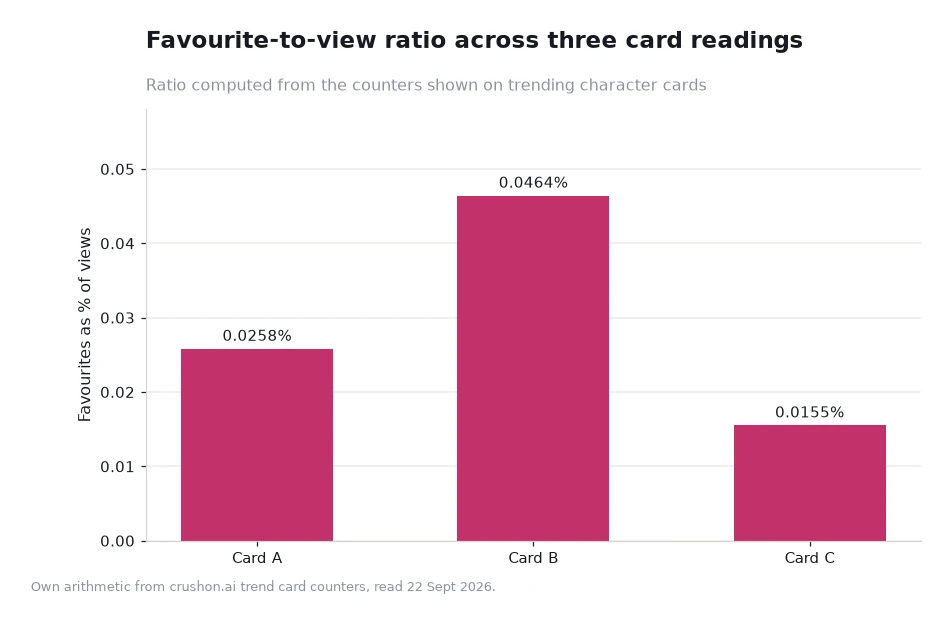
- Card counters separate reach from intent. Saves run at 0.0464%, 0.0258% and 0.0155% of views across three readings.
- Memory is a product feature, not a side effect: Characters, Memories and Creators are separate destinations in the navigation.
- Test with one question: ask for something mentioned earlier and see whether it comes back.
What memory changes about a reply
A reply written from nothing and a reply written from a hundred messages of context are not the same kind of answer. The second can refer back, hold a tone you set, and avoid the details you already rejected. Nothing about the underlying engine has to change for that to happen; only the amount of history available to it does.
This is why two readers can describe the same platform in opposite terms. One keeps a long thread and reports warmth and consistency; the other opens a new conversation every evening and reports that the replies are generic. Both descriptions are accurate, and the difference between them is a habit rather than a specification.
The platform states the mechanism directly: characters recall previous interactions and adapt over time. That is a statement about continuity, and continuity is precisely the thing that a longer conversation accumulates and a shorter one cannot.
Why engine labels make weak predictions
Engine labels are attractive because they look like a specification you can compare. In practice they describe capacity rather than outcome, and a conversation is an outcome. Two threads on the same platform with different context lengths will differ more from each other than two threads with different engines and identical context would.
There is also an upkeep assumption hidden in every engine comparison: both sides are expected to be used the same way. Readers rarely use platforms the same way twice, let alone across two products, so the comparison is usually between two habits rather than two systems. The habit wins.
The practical conclusion is not that engines are irrelevant. It is that an engine label cannot tell you whether a companion will still feel right after a month, while the structure of your own usage almost always can.
There is a testable version of that argument, and it takes two weeks. Run one character in a single thread for ten sessions and record one sentence after each visit about what carried over. Then run the same character for ten sessions as ten separate conversations and do the same. The engine is identical in both halves; the experience will not be, and the notes will show you where the difference sits.
Memory has limits worth stating too. It cannot make a narrow character wide, and it cannot repair a thread whose tone has drifted past the point you wanted. What it does is give you more to work with: a longer shared history, a settled register, and fewer introductions. That is a large advantage and a specific one, not a general upgrade to everything the platform does.
| Signal | What it tells you | How to test it |
|---|---|---|
| Return consistency of a thread | Whether continuity is holding across visits | Reopen the same thread for two weeks |
| Recall of stated preferences | Whether memory is doing useful work | Ask for a detail from an earlier session |
| Save rate on the card | Whether other readers returned | Compare 0.0464% against 0.0155% |
| Creator reputation | Whether the character is built with a consistent voice | Try two characters from one creator |
| Engine label | Capacity, not experience | Treat as context, never as the decision |
Read the last row as a correction rather than a dismissal. Specifications are worth knowing, and they are simply not the variable that separates a companion you keep from one you abandon. Continuity is.
Worked example: counting the context you have built
Context is countable, which makes it easier to reason about than capacity. Take a habit of ten sessions a month at about 12 messages each: that thread carries roughly 120 messages of shared history by the end of the month. By month three the same pace implies about 360 messages, and by month six about 720.
Compare that with the alternative habit of one new conversation per session. Ten sessions produce ten threads with about 12 messages each, and no thread ever accumulates enough context to matter. The monthly message count is identical in both cases, which is the point: the same usage, in the same month, on the same platform, produces two completely different experiences.
The counters on the trend cards follow the same logic. Saves as a share of views read 0.0464%, 0.0258% and 0.0155% across three cards, and a card that converts at nearly three times the rate of another is one whose readers came back. Per 100,000 views that is 46.4 saves against 15.5, a gap that no engine label would have predicted.
Building the habit that uses memory
Three habits turn continuity into an advantage. Keep one thread per character rather than one per evening. Cap the number of active characters, because ten half-open threads means ten sets of fading details. And review the main thread weekly with a single sentence that corrects anything that has drifted.
Then choose the input to that thread carefully. Readers who want to see who is producing characters worth a long commitment can start from https://crushon.ai/, where the navigation separates Characters, Memories and Creators, and browse the catalogue through character search before settling on one. The Creators listing is the underrated half of that pair: a single creator with a consistent voice is a better basis for a long thread than a single popular card.
None of this requires knowing anything about the machinery underneath. It requires deciding that the history of a conversation is an asset, and then not throwing it away at the first flat reply.
Frequently asked questions
Does a bigger model automatically mean better conversations?
No. Capacity is one input, and the context a thread carries usually shapes the felt result more strongly than capacity does.
How can I tell whether memory is working?
Ask for a detail from an earlier session, ideally one you mentioned in passing. If the companion brings it back unprompted, continuity is doing its job.
Should I open a new thread for a new topic?
Only if the old context actively works against the new direction. Otherwise keep the thread and set the change in a sentence, which preserves what it already knows.
Judge the thread, not the label
Pick one companion for the next month, keep the conversation in a single thread, and note what it remembers at the end. That experiment answers the question engine labels cannot, and it costs nothing except the temptation to start over. Adults 18 and over are the intended readership for this piece.
Sources: navigation labels, the response wording and the trend-card counters behind the ratios quoted were read on Crushon on 22 Sept 2026; the session and message totals are illustrative arithmetic rather than platform statistics and no privacy outcome is claimed beyond the client's own phrasing. This article is intended for adults aged 18 or older.[1]