Why Every Brewery Tank Arrives With a Data Plate
A data plate is the smallest piece of paperwork on a brewery tank, and it is often the one that settles a warranty question. Every Hermann shipment is checked in 5 published inspection steps, and every tank that leaves the workshop carries a plate with its pressure-testing record and serial number.

Key takeaways
- Hermann runs 5 inspection steps on every shipment: materials checking, production process, jacket pressure testing, packing and loading inspection, and a finished-product leak test.
- The inspection record travels with the order, and the tank plate repeats the pressure-test result and the serial number.
- Published warranty cover is 6 years on tank accessories and electronic components against manufacturing defects from the factory, used within scope.
- Equipment is packed in wooden boxes and arrives with a checking list, so the plate can be matched to the paper trail before unloading starts.
What a data plate actually records
A data plate is a small tag, usually stainless steel, fixed to the shell of a vessel. On Hermann tanks it carries two lines that matter long after commissioning: the pressure-testing record from the jacket test, and the serial number of that individual tank. Together they turn an anonymous cylinder of stainless into a traceable asset.
The plate is only half of the record. The other half is the inspection record that travels with the order, which means a plate number should always find a matching page in your delivery file. When those two agree, you know the vessel in front of you is the vessel that was tested.
Three questions come up in every working brewery, and the plate answers all three. Which tank is this, when four identical fermenters stand in a row on the same skid? What pressure was the cooling jacket tested to before it left the factory? And which serial number belongs on the spare-parts request for a manway seal or a racking arm?
The five inspection steps behind the plate
The tag is not self-certified. Hermann publishes 5 inspection steps for every shipment, and the pressure test that ends up stamped on the plate is produced by the third and fifth of them. The table below sets out what each step looks at and what you should be able to file afterwards.
| Inspection step | What is examined | Record you keep |
|---|---|---|
| 1. Materials checking | Incoming stainless steel plate and fittings against the specification for the order | Material reference in the inspection record |
| 2. Production process | Welding, forming and dimensional checks while the vessel is being built | Process notes in the same record |
| 3. Jacket pressure testing | The cooling jacket under pressure, before insulation and cladding go on | Pressure-test result, printed on the plate |
| 4. Packing and loading | The crate, the securing inside it and the load as it goes onto the truck | Packing record plus the checking list |
| 5. Finished-product leak test | The completed vessel, filled and held, to catch anything the visual check missed | Leak-test entry, filed with the shipment |
Two of those steps are easy to underrate. Jacket pressure testing is what protects you from a slow leak into the glycol circuit six months into service, and the finished-product leak test is what catches the pinhole that a walk-round inspection never finds. Because both results are written down and both travel with the order, a later conversation starts from evidence rather than from memory.
What to compare on delivery day
Vessels arrive in wooden boxes, and the crate normally carries the checking list alongside the tank. Unload in a dry, level area, keep the crate upright, and then work through three comparisons in a fixed order: crate condition against the packing photographs, plate against checking list, and plate against the copy of the inspection record in your own file.
Photograph each plate while the box is still open. A phone picture of the tag costs nothing and saves an argument later, because it shows the serial number, the pressure-test entry and the crate it arrived in, all in one frame. Transcribe those numbers into your maintenance system on the same day, while the crates are still on site and the delivery note is still on the desk.
It also helps to know who built the vessel. The manufacturer's own overview lists 23 years of experience in craft brewing equipment design, with installation and technical support included in the scope of a project, which is the sort of detail worth confirming before you sign off a delivery.
Storage matters as much as inspection. A tank left unwrapped in a yard collects water in the cone and grit in the fittings, and the warranty wording is conditional for a reason: 6 years on tank accessories and electronic components against manufacturing defects from the factory, used within scope. Reading the plate and storing the vessel properly are two halves of the same habit.
Why traceability survives staff changes
Brewing teams turn over. The person who took delivery of your fermenters may be three jobs away by the time a jacket needs attention, and the delivery note may be a photograph on a phone that has been replaced twice. The plate stays bolted to the vessel, and the serial number on it is the one thread that leads back to the inspection record, the shipping documents and the packing list.
That matters for insurance and for resale as well as for service. A used tank with a readable plate, a matching serial number and an inspection record is a much easier object to sell or to move between sites than one whose history begins with a photograph of a crate in a car park. The same logic runs across the whole brewery equipment range, from mash tuns and kettles to bright tanks and filling machines.
Worked example: where the plate sits in the cost per litre sum
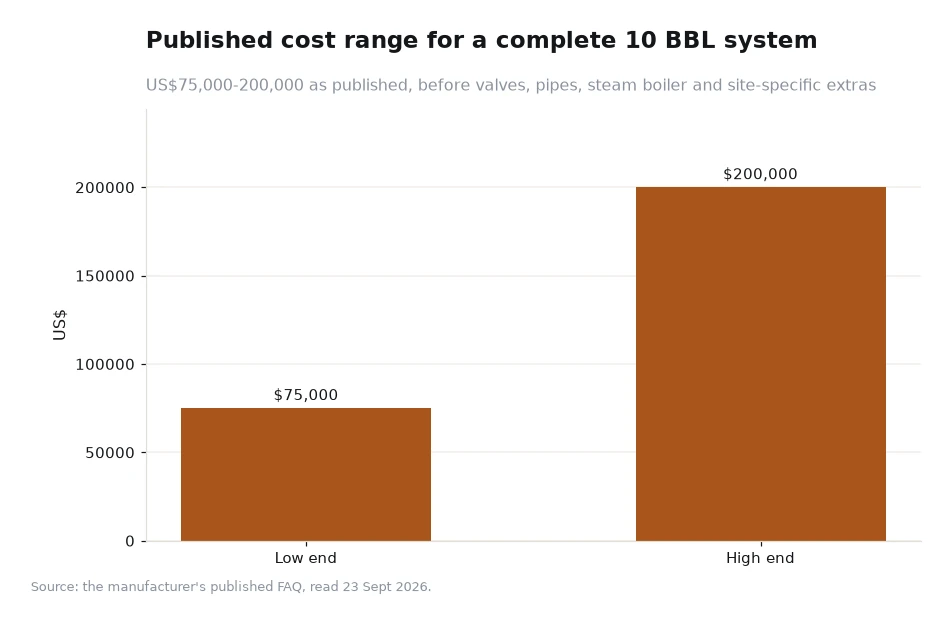
Take a 10 BBL brewery as the illustration and write the assumptions down first. One barrel is treated as about 117 litres, so a 10 BBL batch is roughly 1,170 L. The brewery brews 12 times a month, 12 months a year, which is 144 brews. Losses are ignored, so every litre brewed becomes saleable beer. The package price is taken from the published range for a complete 10 BBL system of US$75,000 to US$200,000, before valves, pipes, a steam boiler and any site-specific extras.
Annual output: 144 brews x 1,170 L = 168,480 L. At the low end of the published range, US$75,000 divided by 168,480 L comes to about US$0.45 per litre in the first year. At the high end, US$200,000 divided by the same 168,480 L is about US$1.19 per litre. Spread the same package across five years at unchanged output, 5 x 168,480 L = 842,400 L, and the low end falls to roughly US$0.09 per litre while the high end falls to roughly US$0.24. These are illustrative figures built on stated assumptions, not a quotation for a specific brewery.
A plate does not alter that arithmetic, but it does change how fast a problem is resolved: the serial number removes the guesswork about which vessel is affected, which batch record belongs to it and which replacement part fits.
Frequently asked questions
Do I need the data plate to make a warranty claim?
Yes. The number on the plate ties the vessel to its inspection record, and the published warranty runs for 6 years on tank accessories and electronic components against manufacturing defects from the factory, provided they are used within scope. Without the plate number, a claim starts with an identification problem before it starts on the fault itself.
What is tested before a tank is shipped?
Five steps: materials checking, the production process, jacket pressure testing, packing and loading inspection, and a finished-product leak test. The pressure-test record and the serial number from those steps then travel on the tank's own plate and in the inspection record that ships with the order.
Getting the paper trail right from the start
Ask for a sample inspection record before you order, and check that the plate layout it describes matches the tanks you expect to receive. Read the tag on delivery day, photograph it, and file it next to the checking list. Keep the two together in one folder, digital or physical, so the next person who works on the vessel can find both in a minute.
If you are still comparing hem craft beer equipment for a new brewhouse, the practical question to ask a supplier is simple: show me a plate, show me the record behind it, and show me where the pressure-test result is written down. A supplier who answers all three quickly is a supplier whose tanks will be easy to live with five years from now. Drawings, site questions and utility requirements can go to the factory through its contact page before the order is placed, when changes are still cheap.
The inspection steps, plate details and warranty wording in this article come from the manufacturer's own website, read 23 Sept 2026; the price range shown in the chart is the published 10 BBL figure from the same source material. [1]